Queer Joy
Joy is found everywhere: in the laughter of children, in the conversations of friends, in the dog barking and running after a frisbee. However, queer people often aren’t the ones seen experiencing it in modern-day mainstream digital media. In this section, we delve into the intricacies of queer joy and analyze its effect on queer people, queer activism, and queer history.

This artifact is Kindred Spirits, an archival pigment print photograph by Chloe Sherman, 1994, in San Francisco. The photograph depicts two personal friends of Sherman, Tai Uhlmann and Alessandra Ogren, in an embrace, both clad in black kippot (skullcaps). This photograph has gained notoriety for its portrayal of a Jewish butch couple who are both visibly lesbian and Jewish. As Sherman herself is a Jewish lesbian, captured in this single photograph is a unique perspective of queer Jewish existence, as created by an ingroup individual rather than an outsider. As with queer existence, to be a Jew is to exist beyond the pale of an assimilated society. Racialized as perverting Christian standards of sex and gender, our men are depicted as weak, emasculated, nervous; women are pigeonholed as abrasive, masculinized, and vicious. The features of our bodies are assumed to betray the nature of our race. We are demoralized and ostracized even within queer and progressive spaces; our loyalties are constantly in question, for we are thought to be more loyal to those within our tribe than outside it, more dedicated to Israel than the nations of our parents. Perhaps this is true in some respect; to protect our threatened culture and existence, standards of modesty and conduct regarding sex and sexual habits have been determined by our Sages. Marking us separate from a greater assimilated norm, it bears the double bind of strengthening the estranged relationship between sexes. In the photo, Uhlmann and Ogren defy expectations of how Jewish women dress, donning kippot and the formal attire of men in collared shirts and suit jackets. These women are two of countless Jews who could be classified today as homosexual and transsexual. Evidence of our existence has been notably present in the Midrash and codes of Jewish law, where as many as six distinct sexes are described on the basis of fecundity, outward sexual characteristics, and ambiguity of genitalia. Corroborated by experiences of other Indigenous groups, “many Indigenous terms for third gender people contain both the word for ‘man’ and ‘woman’ in their construction, and that third gender people are seen as embodying both of those genders in diverse ways,” “Interactive Map: Gender-Diverse Cultures.” PBS. There is discourse, particularly in Orthodox spaces, about the social dilemma posed by transsexual Jews as related to the disruption of modesty laws and sex separations in public spaces. Orthodox authorities seem to agree that medical transition is against Biblical law and does not a man or woman make, respectively. This is in direct contradiction to their attitudes toward infant cosmetic surgery for intersex births, despite descriptions of their presence in the Midrash. Regardless of opinion, here is proof that we lived here, that we were joyous despite our subjugation. We, too, are the children of Israel, and we bow our heads toward Jerusalem when we pray. For it would be worship of idols to prostrate ourselves at the altars of those who would prefer us to assimilate rather than survive raucously.

This photograph is titled “Black and White Women Together.” It was taken September 19th, 1984 at the International Gay and Lesbian March, which possibly refers to the International March for Gay and Lesbian Freedom that took place on September 30th, 1984 in New York City. This march is not very well-known because there were not many participants, but they marched from Sheridan Square to Dag Hammarskjold Plaza across from the U.N. to fight for the freedom to live openly as gay men and lesbians from youth to old age (ish 8). Though the women in the photo are unknown, it was taken by Bettye Lane, a well-known photojournalist of many political movements such as the feminist movement, the civil rights movement, and the gay rights movement. The women depicted in the photograph are clearly smiling with their arms around one another; their body language is the embodiment of queer joy. Despite this picture being taken in the 1980s, a tumultuous period in the gay and lesbian community due to AIDS and other civil rights struggles, these women still find joy with each other. Additionally, this period was fraught with racial tensions in the gay rights movement after the rise of the ethnic model of identity, which emphasized the notion of a singular gay identity as the most important facet of one’s identity. Lesbians and gay people of color were frustrated by the implications that they would have more in common with white lesbians and gay men than with their own ethnic or racial communities (Jagose 63), leading to a rise in BIPOC LGBTQIA+ people forming their own organizations. Though much research focused on the development of one singular adult identity, there are increasing studies on multifaceted identities like sexual versus ethnic identities and how they develop (Jamil, Harper, and Fernandez 3). Still, despite the tensions of the time, these two women, one white and one of color, show solidarity with one another, revealing that joy can exist even in hard times. This photograph shows that there will always be allies, and there will always be joy.
The short story, “A Gentle Kiss,” was written by Ingrid Race and submitted to the October 1964 issue of The Ladder, the publication of the Daughters of Bilitis. Founded in 1955, the Daughters of Bilitis were the first major organization for lesbians in the United States (Cohen 1). Though nothing is known about the author, Ingrid Race, women from all over the country submitted works to be published in The Ladder, many using pseudonyms to protect their identities. It was a way for them to express themselves and their sexualities, as well as become informed on lesbian issues around the country and have their creative voices heard. The story is about a woman named Ren who returns to a long lost lover named Michele. She is let into Michele’s home by Michele’s landlady and waits for her to return from work, reminiscing about their past. Upon Michele’s turn, they share a kiss. Though Race does not reveal too much information about their past, it can be assumed that Ren previously rejected Michele, but now she has come to terms with her sexuality and can be with the woman she loves. This illustrates queer joy: Ren finally frees herself from the confines of society, and she can embrace every part of herself, including her queerness, to be happy; “the queer unhappiness that had lived with her so long was suddenly gone” (Race 55). Many other lesbians likely experienced this same struggle, and upon reading Race’s work, they learned that, even though the story is presumably fictional, they can be happy. They deserve to be happy.
Shown below is a 1993 “From the Heart” poster — an advertising flier and charity cookbook for and by the AIDS Service Agency. The fifteen-dollar cookbook serves as a special way to raise extra money for the non-profit organization. The proceeds were directly linked to supporting those with HIV or AIDS in Wake County, a county in North Carolina. As put in The Fundraising Authority, “The basic idea behind cookbook fundraising is that your organization pulls together 100-1000 recipes written by your members, donors, volunteers and other supporter, and then works with a cookbook publishing company to cheaply print the books. Your team then sells the books to earn money for your organization.” In this specific cookbook, the recipes are compiled from both regular folks and famous people such as Hilary Clinton, Elizabeth Taylor, Woopi Goldberg, Randy Shilts and many more. The cookbook is a good way to bring attention to the AIDS Service Agency in a wholesome and intriguing way. Though the artifact is tied to a saddening time in history, this poster serves as a nourishing reminder of the many heroes who worked to fight against the epidemic. Not only this but it connects a larger community to the feeling of being seen and feeling joy through food.


"When Josylyn and I met there was an immediate sense of identification. We were two passionate Third World Jews who didn't fit into the prevailing Jewish stereotypes." – Rachel Wahba "Most American Jews think that looking ‘Jewish' means fitting into the appearance, culture and lifestyles they are most familiar with, that of their immediate forebears who came from Eastern and Northern Europe. Anything else challenges the stereotypes." – Josylyn C. Segal Attached is the image of friends and companions Josylyn C. Segal and Rachel Wahba embracing in laughter, from the chapter, “You Don’t Look Like a Jewish Lesbian,” from Nice Jewish Girls: A Lesbian Anthology. As self described “Third World Jews,” Josylyn and Rachel reflect the cultural and ethnic diversity inherent to post-diaspora Judaism, a diversity that few gentiles are conscious of; it is one that even some Jews assimilated into whiteness and secularism deny and fail to honor and acknowledge, for fear of becoming too complex or obscure for the greater non-Jewish world to understand or respect.
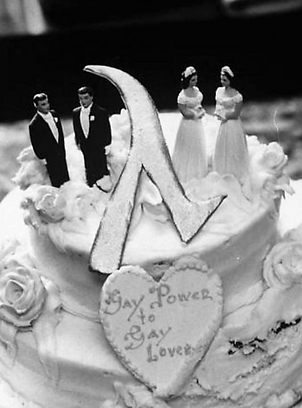
This artifact is a photo of a wedding cake with two gay couples on the top, a gay couple on the left, and a lesbian couple on the right. This photo was taken on June 4th, 1971, and is an example of queer joy. It was made because of the legal threats Clerk Herman Katz made against same-sex marriage. From this threat Arthur Evans, Marc Rubin, and Vito Russo who are members of the GAA which is the Gay Activist Alliance came together and made a plan. With the help of a few other members, they went to Katz's office with the wedding cake and told everyone there that there were going to be two weddings. This is showcasing queer joy in a few different ways, the first being how they happily brought this wedding cake to an office they weren’t particularly welcomed in and still offered everyone to participate in the wedding. Secondly, this wedding cake is displaying queer joy through marriage, which is known to be a joyous occasion for anyone, and it shouldn’t be prohibited to just heterosexual couples. Finally, the cake has a heart in the center with the text, “Gay Power to Gay Lovers,” they are telling everyone the importance of love and that it can be between any person.