Queer Grief
Grief in itself is widely understood as an objectively complex emotion. This section explores and displays tones of grief as it pertains to the queer experience. Content in this section touch on topics that may be distressing for some, including the AIDS epidemic and the Pulse massacre.

This artifact is one out of many quilts that have been made to represent the lives that have been lost because of the AIDS epidemic. AIDS quilts are still being made to this day, and serve not only as reminders of those lost, but also as symbols keeping this critical issue in the public eye. This particular quilt project was created by Cleve Jones in 1985 when his friend Marvin Feldman died from AIDS. Many of Jones’s quilts were showcased in front of the Washington monument in October 1996. In a journal article written by Gregg Stull who helped with the 1996 event, Stull talks about the enormous display and about how many people went to view it, noting that “over a million visitors walked among the panels, including, for the first time, the president of the United States. Among the visitors were thousands of school children, families with strollers, and people of all colors” (Stull, 2001 p. 5)). Anyone can view each and any single quilt from the AIDS memorial website. These quilts are very important to the LGBTQ+ community because they can help everyone remember those who had passed from the AIDS epidemic. The height of the AIDS epidemic was an incredibly scary and sad moment for the LGBTQ+ community as people were dying in shocking numbers, and nobody knew how this was happening. The documentary “How to Survive a Plague” shows the grief and fear all these people went through as some of them even acknowledge the fact that this might kill them. Peter Staley, a person featured in the documentary, grimly says, “I’m going to die from this,” (How to Survive a Plague 7:50-8:00). His fear highlights the theme of queer emotion as the AIDS quilts, and the AIDS epidemic itself, keep the grief of the LGBTQ+ community caused by the epidemic as an important learning moment in history. This quilt shows grief in a few different ways. First is representing and seeing the lives of the deceased, like featuring imagery representing people’s interests and legacies. For example, on the quilt there is a photo of Mickey Mouse, which shows that the person could be a fan of Disney. Another is seeing the photos of them and their families.. There are many other quilts out there that tell the stories of the people who have died from this disease and it's very important to remember those who should have been around longer.
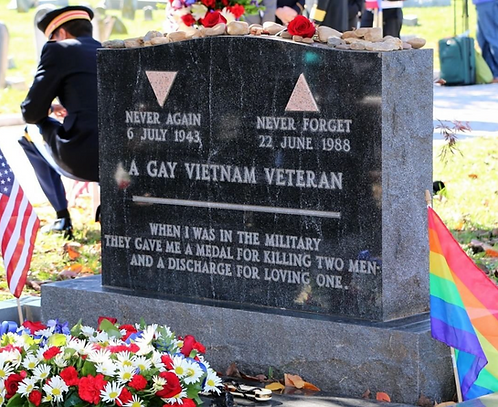
This photo depicts the gravestone of gay American Vietnam veteran Leonard Matlovich, located at the Congressional Cemetery in Washington D.C.. leonardmatlovich.com states “Leonard personally designed his internationally known tombstone, incorporating the same kind of reflective black granite that was used in the construction of the vietnam veterans memorial wall, inset with his famous quote and pink triangles referencing the emblem used to mark gays in nazi concentration camps.” Matlovich was expelled from the air force after being discovered as gay, 18 years before “don't ask, don’t tell” was implemented. He tragically passed away in 1988 at the age of 44 as a result of complications from AIDS. His tombstone, as well as the context and history behind it, speak directly to the experience of queer grief due to its nature of such a heavy and tragic loss - more specifically, a loss that could have been prevented if our healthcare system was kinder to and cared about AIDS patients. Matlovich’s cause of death being closely tied with an issue that has impacted the queer community so heavily throughout history adds to the complexity and multifacetedness of this grief. This artifact connects with the photo of the staged “die-in” organized by ACT UP members in front of the American Medical Association headquarters, in its relation to the AIDS epidemic. Looking at this artifact, representing queer grief, in conjunction with the “die-in” photo, representing queer anger, displays the multifacetedness of queer emotion, specifically in the face of tragedy and injustice.
Andrea Gibson’s poem ‘Orlando,’ was released in September of 2017 as a response to the Pulse nightclub shooting, which was the deadliest mass shooting in US history at that time (June 12, 2016). As a queer-identifying person themself, Gibson (b. 1975) describes the grief, shock, and fear shared by the LGBTQIA+ community. Gibson recounts the experience of performing the night following the massacre, describing their hypervigilance through “scouring the club for the fastest route to every exit”. This exhibition’s theme is queer emotion, exploring how queer feelings are multifaceted and interconnected; Gibson weaves their emotions throughout the poem regarding the aftermath of the event. In reference to the day after the massacre, they state “everyone around me spent that day grieving, and every tear tasted like someone’s dance sweat drying in the morgue.” Studies on the impact of the Pulse shooting on the LGBTQ+ community confirm that Gibson wasn't alone in their feelings of fear and grief. Stults et al. (2017) conducted a survey of 1,395 LGBTQ+ adults that evaluated perceptions of safety following the massacre, finding that levels of fear regarding safety increased in individuals of all LGBTQIA+ identities; however, those with more marginalized identities (for example: genderqueer, transgender, or queer poc) displayed higher levels of distress and unsafety than those whose identities carry more privilege (such as cisgender males). Unfortunately, these feelings of unsafety have existed in the LGBTQ+ community throughout history. The Mattachine Society (est. 1950) was a well-known organization of gay men who often gathered in secret to protect their safety (Katz, 1976). In ‘Orlando,’ Gibson refers to Pulse as “the only place they thought they did not have to hide,” emphasizing that Pulse was meant to be a safe and protected place for LGBTQ+ individuals. One way that this poem contributes to LGBTQ+ history is its expression of complex emotions regarding queer experiences in the face of tragedy. Gibson’s words in their poem, as well as their delivery of them, helps to humanize a group of people whose painful experiences have historically been dismissed by predominantly straight societies in the US.
“Beyond Compassion,” Remarks by Randy Shilts was originally a speech presented at the V International Conference on AIDS Montreal on June 19, 1989. Randy Shilts (August 8, 1951 – February 17, 1994)was an American journalist and author who became internationally influential in changing the way the news media covered the AIDS epidemic. As a prominent, openly gay journalist and author, Shilts was highly significant. The speech served as a reflection of the epidemic up until that point, pressing out many of the United States’ faults and successes of the past as well as his hopes and concerns for the future. In the speech, Shilts writes his hopes and worries for the future, as in 1988 the future of the epidemic was very much unsure. There were over 800,000 worldwide death rates at the time. Shilts uses his platform to emphasize his emotions and to call out the audience of reporters, writers, scientists, and activists to be held accountable and not let faults go unchecked. Shilt’s work emphasizes the complex spectrum of emotions that the queer community has experienced during the AIDS epidemic and beyond. In the same way the 2012 American documentary How To Survive A Plague captured the messy responsibilities and hidden joys of the 1980s New York queer community in film, Shilts does the same in writing. So, in what ways does this work impact a broader queer experience? Shilts captures a time in history when queer people were arguably the most uncertain. Their emotions are in the backbones of our people today. As Kristin LaFollette puts it in her book Queer Approaches: Emotion, Expression and Communication in the Classroom, “Ultimately, emotions can fuel teaching and learning toward identity affirmation, affective literacies, and socially responsible literacies and action (LeBlanc & Gallavan, 2009; Summers, 2016). Emotions serve young people’s coming of age and individual and collective questioning about their identities and social capital (Miller, 2012, 2016).” Emotions of the past dictate the future. “Beyond Compassion” serves as a bookmark in the narrative of queer emotions.
Excerpt from the novel in verse, Autobiography of Red, by Anne Carson. The novel follows the myth of the tenth labor of Herakles as told by the ancient verse poet Stesichoros; the slaughter of the red monster Geryon to gain his magic cattle, reimagined as a modern queer tragedy of loss and heartbreak. Geryon is a thoughtful and introspective boy with red skin and leathery wings. He grew up sexually abused by his brother and neglected by his mother. Isolated from his peers by his own monstrousness, he has worked diligently since childhood on an autobiography, which has evolved into a collection of compiled photographs. By complete coincidence, he collides with the volatile Herakles; a golden pleasure-seeker who grew up at the foot of a semi-active volcano in his hometown of Hades, who seems to be running eternally from his own fears of intimacy. The attached pages, entitled WATER, describe the experience of de-reality one experiences after being totally consumed by heartbreak for the first time. There is a loneliness about heartbreak and the ending of fundamental intimate relationships that is unique to the queer experience. To know and love another human being in queer intimacy is to find in them a safety from the often harsh world outside oneself. To lose that love and that person is to lose that sense of safety and security. It is in a way a kind of death, the death of possibility, the death of community, the death of interdependency. Every queer person has known a form of loss in this way, regardless of the kind of relationship. The monstrous absoluteness of this grief changes a person from who they once were. The hum of abject aloneness that resonates from these pages takes your breath away, appealing to one’s own experiences of the destructive endings of a love gone too soon from one’s life, and the aftershocks felt for lifetimes afterward.
A Primer for the Small Weird Loves is a poem from the acclaimed poetry collection Crush, by Richard Siken. Its narration carries the reader through depictions of early childhood homoeroticism and subsequent violence to the learned abuses of adulthood, with its demeaning sexual experiences and the twisted knife of unrequited, toxic, or badly-timed love. The overwhelming feeling from this poem is wrongness; in every moment, whether front and center stage or in some distant cobwebbed corner, something about you, him, or us, is irrevocably wrong. This wrong is something you were either born with or earned somewhere along the line with mistakes and misdirection. It is always there even though it is always different; it is the man that is wrong, or the timing, or the color of his eyes; it is the quality of your love for him, or the way he does not love or even care for you beyond your convenience to him as a sexual object. Otherwise it is just you who is wrong. Innately you were made faulty, unable to love properly in a way anyone could ever return to you. This poem is the embodiment of that metallic taste of isolation queer intimacy and love is often colored by, when it is shared by people who are too broken-hearted or weak-willed to look each other in the eye and tell the other about their fear. When love is pure it is compassionate and connective. When love is corrupted, it is not love at all; it is the vicious desire to win at any cost; or at least not to lose. The sense of desperation to feel seen by another person is the need to be touched that you might once again become physical. This is a consequence that comes from a collective trauma like the AIDS epidemic or waves of homophobic violence, and this clinging desire can often take precedence over the need to feel loved and secure. When one’s life is colored by danger, violence, death and disease, there can accompany a person a persistent feeling of hopelessness and disbelief in the reality of love and compassion for and by other people. Too much of queer love and intimacy is impacted painfully by internal feelings of mistrust, doubt, and self-hatred. It becomes a vicious cycle when you believe you are unlovable, as you go out into the world and only open your heart, mind, or body to those who believe the same about themselves, and thus cannot be compassionate or vulnerable in the way one deserves.